The Loomerang Standard
Matt
Co-founder
Loomerang’s Customer Promise
There's a moment that happens a lot in the world of made-to-order apparel.
A designer pours weeks of work into perfecting their design, uploads it to a platform, and waits. A customer falls in love with that design, makes a purchase, and when the shirt finally arrives, the colors are dull, lines are soft, and the design is placed awkwardly. Something was lost in translation from screen to fabric.
At Loomerang we believe that moment should never exist.
Quality as our Top Priority
When we started building Loomerang, we knew that quality wasn't something we could just promise. We had to deliver.
That meant testing. A lot of testing. We worked through multiple suppliers, adjusted file settings, changed printer configurations, and ran print after print until we understood exactly where the gaps were and how to close them. We weren't looking for "good enough." We were looking to fulfill the actual vision of the designer. Something the designer and the customer would be proud to hold in their hands.
That process led us to build partnerships with suppliers who share our standards, and to develop a set of internal specifications for how every file gets prepared before it ever touches a printer. The result is a workflow built around one question: does this do the art justice?
Why We Use DTF Printing
Direct-to-Film (DTF) printing is the method we landed on as our core process, and the reasons are straightforward.
DTF lays ink directly onto a transfer film, which is then heat-pressed onto the garment. The result is a print that sits on top of the fabric with vivid color accuracy, sharp edges, and a feel that holds up through real-world wear and washing. Unlike older methods that can crack or fade quickly, DTF produces a flexible, durable finish that stays true to the original design.
“We've spent months dialing in the settings that get the most out of this process. Ink density, press temperature, press duration, film quality, and how files are prepared before they hit the printer are all variables that we have tuned over time.”
The Blanks We Use Are Part of the Equation
A print is only as good as what it's printed on. We source quality blanks that give DTF printing the right surface to work with, a consistent fabric weight, a tight weave that holds detail, and a feel that wears comfortably. We're not cutting corners at the base layer to save a few cents per unit, because those savings show up in the final product in ways nobody wants.
The Loomerang Standard QA Checklist
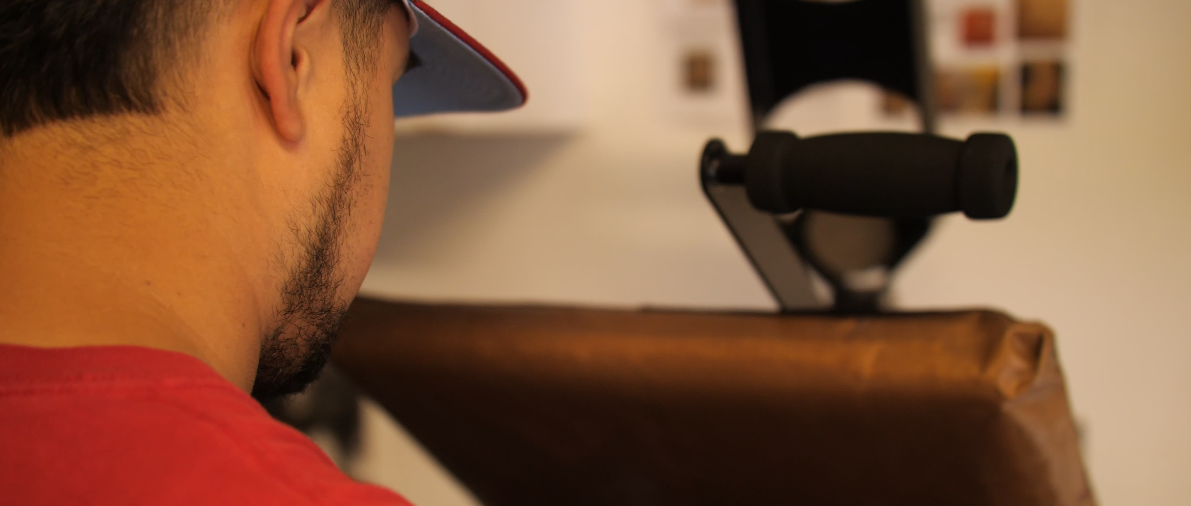
Something else that doesn't happen everywhere: before any order ships, a member of our team looks at it.
Not a sensor. Not an automated pass/fail. A person.
If something doesn't meet our bar, it doesn't ship. This is the Loomerang Standard. We treat every designer's work with the care and intentionality it deserves, because it isn't just a product to us. It's someone's art.
The Loomerang Standard QA process checks:
1) Print color accuracy against the original design
2) Edge sharpness and detail clarity
3) Print placement and alignment
4) Overall garment condition before packaging
Every order, every time.
Made-to-Order Benefits
Traditional apparel production runs on volume. Thousands of units get made in advance, inventoried, and then either sold or not. The ones that don't sell get discounted, warehoused, or in a lot of cases, destroyed. It's a model with a huge amount of waste.
We make things when they're ordered. That's it. No overproduction. No excess inventory sitting in a warehouse. Every shirt that exists was made because someone wanted it, which means we're not contributing to the mountain of unsold apparel that the industry has normalized.
For designers, this also means zero risk. Selling on Loomerang doesn't require buying stock in advance or gambling on how many units might sell. Our designers create, list, and we handle the rest when the orders come in.
Keeping it Local
We're intentional about where our pressing and fulfillment happens. By keeping our production and shipping as local as possible, we're doing two things at once: getting orders to customers faster, and reducing the environmental cost of long-distance shipping.
We believe that a platform built around independent designers should also be one that's thinking seriously about its impact. Made-to-order production, local fulfillment, and quality-first manufacturing are all part of the same philosophy: build sustainably, build for quality, and build with intentionality.
What This Means for Designers
If you're an independent designer thinking about where to bring your work to life, here's what the Loomerang Standard means in practice:
Your work becomes a product that's been tested, refined, and quality-checked before it reaches your customer. We've done the work to make sure that the gap between your design and the final garment is as small as it can be. And when an order ships, it ships because someone on our team looked at it and said yes.
We've built something that takes your work seriously. That's the whole point.
What This Means for Customers
Responsible, sustainable fashion, where you know exactly who you are supporting when you make your purchase.
You get a design that you love, with the reliable quality that Loomerang promises. No more guessing if you will get something that looks like what you ordered. With Loomerang, you can count on things being done the right way.
About the author
Matt
Matt is the Co-founder and President of Loomerang where he guides business strategy and designer partnerships. Matt has built a career at the intersection of art and technology and is passionate about building the platform that independent designers deserve.
©2026, Loomerang.